Case Study in Attempting to Establish High Speed Rail: Florida’s Experience
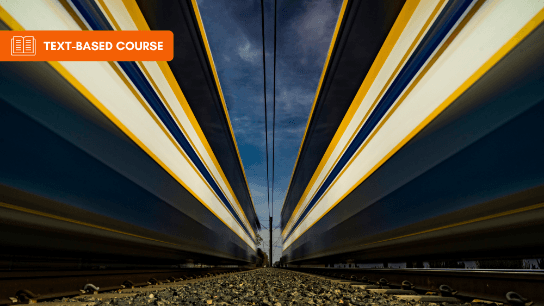
This PDH engineering online course discusses the problematic relationship between speed and financing for high speed passenger rail projects. On the one hand, to have any hope of financial viability a rail line must be sufficiently fast to attract passengers who would otherwise fly or drive. On the other hand, the higher the speed, the more expensive the line is to build and operate. Thus passenger fares must be set high, which hurts ridership. In this course, the experience of the State of Florida between 1981 and 2011 is used as an example. During this time period, Florida and private corporations, sometimes jointly, sometimes alone, made four different attempts to implement rail lines between Miami, Orlando, and Tampa, on which trains would run at speeds between 150 and 220 miles per hour. Yet, in the immediate future, the only new passenger line that is likely to begin operations between these cities is not very high speed and will not run on dedicated track.
This course describes how both actual and perceived speed are related to obtaining financing and the implications of this relationship not only to potential high speed rail projects in Florida but also in Texas and California, where such projects are also being considered. Topics: Political context for high-speed rail in Florida Major actors in the rail development process Florida high-speed ground transportation act of 1984 Financing through real estate development Financing with debt
Civil Engneering faculty member for 27 years
Dr. Rossow is a graduate of the University of Michigan with B.S., M.S., and Ph.D. degrees. He is a licensed Professional Engineer in the State of Illinois. He taught civil engineering for over 35 years, including six years at Washington University in St. Louis and 29 years at Southern Illinois University Edwardsville, where he was the Chair of the Civil Engineering Department for ten years. His areas of expertise are in civil engineering and mechanics. He has consulted for various organizations, including government agencies and an international offshore drilling company. He has published numerous technical journal articles and technical reports for a variety of governmental agencies and private sector organizations. Mark P. Rossow, PE, PhD Licensed Professional Engineer in State of Illinois License No. 062.040560 Dr. Rossow is a graduate of the University of Michigan with B.S., M.S., and Ph.D. degrees. He taught civil engineering for over 35 years, including six years at Washington University in St. Louis and 29 years at Southern Illinois University Edwardsville, where he was the Chair of the Civil Engineering Department for ten years. His areas of expertise are in civil engineering and mechanics. He has consulted for various organizations, including government agencies and an international offshore drilling company. He has published many journal articles and technical reports.
