Build climate-ready communities by mastering the design of adaptive urban environments that seamlessly unify modern water management, strategic zoning, and resilient civil engineering.
Flood risk is increasingly becoming one of the most significant challenges facing urban infrastructure systems. Climate change, urban intensification, ageing drainage networks, and development within flood-prone areas are placing growing pressure on existing infrastructure and exposing communities to more frequent and severe flooding events. While traditional approaches have often focused on increasing drainage capacity, experience has shown that flood resilience depends on a far broader understanding of how land use, stormwater systems, infrastructure planning, and community development interact.
Effective flood management requires an integrated approach that extends beyond hydraulic design. Engineers, planners, asset managers, and infrastructure owners must consider catchment behaviour, overland flow paths, development controls, floodplain management, infrastructure resilience, and long-term adaptation strategies. Decisions made during planning and development can have significant consequences for flood risk, network performance, and community resilience for decades to come.
This session examines how flood resilience can be strengthened through the integration of stormwater management, land-use planning, and infrastructure decision-making. Participants will explore the relationship between development patterns, drainage performance, flood risk assessment, and infrastructure planning, while gaining practical insight into the strategies being used to build more resilient communities and infrastructure systems.
Key Topics Discussed:

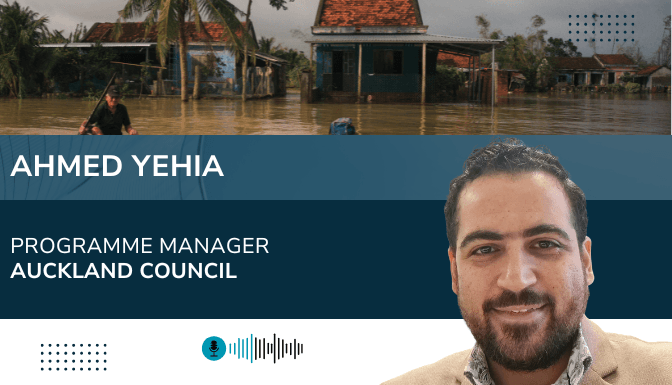
Programme Manager | Auckland Council
With over 17 years of experience in infrastructure planning, design, and management, Ahmed Yehia specializes in developing adaptive and resilient infrastructure systems. In his role at Auckland Council, he focuses on reviewing and publishing technical guidance documents that support infrastructure design and planning across the region. His work contributes to the development of sustainable solutions that address future challenges while meeting regulatory standards. Throughout his career, Ahmed Yehia has held diverse roles in wastewater management, hydraulic modeling, and civil engineering. He has contributed to project management, technical oversight, stakeholder collaboration, capacity building, and staff coordination. He is committed to fostering sustainable infrastructure that aligns with environmental objectives and community needs.
