Discover how AI transforms static simulations into dynamic digital twins that drive real-world value. Learn to engineer trustworthy, predictive systems through actionable frameworks.
This session provides a comprehensive exploration of the next generation of decision-support systems, focusing on the integration of Artificial Intelligence within the Digital Twin landscape. We begin by establishing a strategic foundation through the Gemini Principles, examining how AI serves as a "force multiplier" to move models from static representations to predictive, prescriptive engines.
The session introduces ALMA (Aotearoa Large-Scale Multi-Agent platform) as a primary case study, detailing the technical workflows of Synthetic Population generation and Agent-Based Modelling to simulate 5 million virtual New Zealanders. Central to our discussion is the engineering rigour of VVUQ (Verification, Validation, and Uncertainty Quantification), which ensures these models are reliable for high-stakes applications in public health, urban planning, and climate resilience.
Finally, the webinar looks toward the horizon, proposing an ethical framework rooted in ethics as a driver for innovation, and discussing the roadmap toward a connected national digital twin ecosystem for New Zealand, informed by international best practices.

Data Science & AI Lead | PHF Science
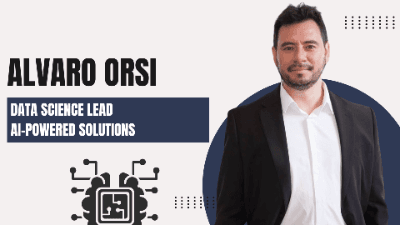
Alvaro Orsi is a data science leader spearheading AI-driven innovation across scientific and business domains. As Data Science Lead at ESR, he leads the development of cutting-edge, AI-powered solutions using technologies including generative AI, digital twins, large population models, geospatial data science, and time series forecasting. Throughout his career, Alvaro has applied AI and advanced analytics across a wide range of sectors, from supply chain logistics in primary industries and vegetation remote sensing to productivity forecasting and the delivery of data-driven insights for government agencies. He brings deep experience from his previous role as Principal Scientist at the PlantTech Research Institute, along with a background in computational astrophysics gained across Spain, the UK, and Chile. This global perspective underpins a research portfolio of more than 80 peer-reviewed publications spanning astrophysics, machine learning, remote sensing, and epidemiological data science. Alvaro is a board member of the AI Researchers Association of New Zealand and leads the National Digital Twin Initiative within the AI Forum’s Architecture, Engineering and Construction Workgroup. He is committed to shaping the future of data science in New Zealand and beyond, advancing AI-powered solutions that deliver meaningful economic, societal, and environmental impact.
