
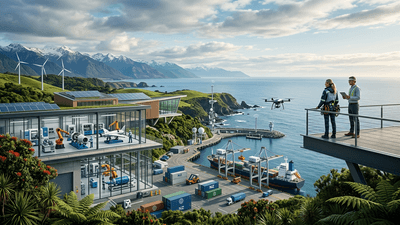



For decades, New Zealand's geographic isolation was viewed as a hurdle for heavy industry and advanced manufacturing. The prevailing wisdom suggested that while we could design world-class solutions, scaling them for a global market required offshoring production. Today, that narrative has been entirely rewritten. Driven by homegrown ingenuity, strategic international partnerships, and a commitment to pioneering environmental technologies, New Zealand engineering is no longer just holding its own—it is setting global benchmarks.
From precision roll-forming technology exported to the world, to cutting-edge plasma arc facilities destroying harmful refrigerants locally, the scope of what is possible within Aotearoa is expanding rapidly. For local engineering professionals, this evolution presents a wealth of opportunities, demanding new skills, cross-disciplinary collaboration, and a globally minded approach to local problem-solving.
The Vanguard of Advanced Manufacturing: Retaining IP, Scaling Globally
The traditional model of exporting raw materials and importing finished technology is being actively disrupted by local firms proving that high-value, precision manufacturing can thrive in New Zealand. A prime example is Auckland-based Howick Limited, recently spotlighted by Advancing Manufacturing Aotearoa for its remarkable success as a global force in construction technology.
Howick specializes in precision light steel roll-forming machines—technology that is fundamentally changing modern construction by enabling highly accurate, off-site manufacturing (OSM). Rather than shifting manufacturing overseas to cut costs, Howick has doubled down on its New Zealand base, keeping its research, development, and production tightly integrated.
Practical Implications for Mechanical and Industrial Engineers
The success of firms like Howick signals a crucial shift for mechanical, mechatronics, and industrial engineers in New Zealand:
- Tightened Feedback Loops: Co-locating R&D with the manufacturing floor allows engineers to iterate designs rapidly. This proximity reduces the friction typically associated with overseas production runs.
- Focus on Automation and CNC: To remain competitive globally while manufacturing locally, the reliance on automation, robotics, and advanced CNC machining is paramount. Engineers must upskill in systems integration and automated quality assurance.
- Exporting Capability, Not Just Products: Howick isn't just selling machines; they are exporting a modern method of construction. Engineers are increasingly required to understand the end-user's operational environment—whether that's a modular home builder in North America or a commercial developer in Europe.
"The ability to maintain precision engineering standards while scaling production from a New Zealand base proves that our local manufacturing sector can compete—and win—on the global stage by focusing on high-value, high-tech outputs."
Pioneering Environmental Engineering: The Kawerau Plasma Arc Plant
While advanced manufacturing is driving export growth, specialized environmental engineering is solving critical domestic challenges with world-first applications. Recently, New Zealand marked a major environmental milestone with the opening of a NZ$10m refrigerant destruction plant in Kawerau.
Historically, New Zealand had to ship harmful synthetic greenhouse gases—such as hydrofluorocarbons (HFCs) and chlorofluorocarbons (CFCs)—to Australia for destruction. The new facility, utilizing advanced steam plasma arc technology, changes this dynamic entirely. Operating at temperatures exceeding 10,000 degrees Celsius, the plasma arc breaks down the molecular bonds of these potent greenhouse gases, neutralizing them locally and safely.
New Frontiers for Process and Chemical Engineers
This facility is more than an environmental win; it is a masterclass in complex process engineering. For New Zealand's chemical and process engineers, the Kawerau plant represents the cutting edge of industrial ecology.
- High-Temperature Thermodynamics: Managing a steam plasma arc requires precise control over extreme thermal dynamics, demanding rigorous safety protocols and advanced materials engineering to prevent equipment degradation.
- Closed-Loop Environmental Systems: The plant captures and neutralizes the acidic byproducts of the destruction process (such as hydrofluoric acid), converting them into safe, manageable salts. This requires sophisticated scrubbing and chemical dosing systems.
- Regulatory and Compliance Engineering: As New Zealand tightens its Emissions Trading Scheme (ETS) and environmental regulations, engineers will increasingly be tasked with designing systems that not only meet compliance but actively remediate legacy pollutants.
Forging Global Partnerships for Local Resilience
While local innovation is crucial, addressing New Zealand's massive infrastructure deficit requires global expertise and capital. Recognizing this, international engineering and construction giant Webuild has formally partnered with Infrastructure New Zealand. This partnership is designed to support the country's vision for a sustainable, resilient, and well-connected future.
Webuild (which includes its subsidiary Clough) brings extensive experience in delivering complex, mega-scale infrastructure projects—from renewable energy hydro-dams to mass transit rail systems. By aligning with Infrastructure New Zealand, they are signaling a long-term commitment to the local market, advocating for better procurement models, and bringing global best practices to local shores.
What This Means for Civil and Structural Engineers
For civil, structural, and geotechnical engineers, international partnerships of this scale offer significant professional advantages. Working alongside global tier-one contractors exposes local engineers to advanced project management methodologies, novel risk-sharing contracting models (such as alliances and early contractor involvement), and large-scale sustainable design practices. It also provides a level of pipeline certainty that has historically been lacking in the New Zealand infrastructure sector.
New Leadership for a Dynamic Era
To navigate this period of rapid technological advancement and global integration, the engineering profession requires visionary leadership. This was recently solidified when Kennie Tsui was welcomed as the new President of Engineering New Zealand Te Ao Rangahau.
Tsui’s election brings a fresh, dynamic perspective to the organization. With a strong background in energy, climate change strategy, and public sector leadership, she is uniquely positioned to guide the profession through its current evolution. Her leadership underscores the importance of diversity in engineering thought, the integration of Te Ao Māori into engineering practices, and the urgent need to address climate resilience head-on.
Under her guidance, Engineering New Zealand is expected to strongly advocate for the profession, ensuring that engineers have a prominent voice in government policy, infrastructure planning, and environmental stewardship.
Mapping the Growth Vectors
To understand the multi-faceted nature of New Zealand's engineering evolution, we can categorize these recent developments across different sectors:
| Sector Focus | Recent Milestone | Primary Engineering Disciplines | Strategic Impact on NZ |
|---|---|---|---|
| Advanced Manufacturing | Howick Ltd's global construction tech expansion | Mechanical, Mechatronics, Industrial | Retains IP locally; exports high-value machinery; advances off-site manufacturing globally. |
| Environmental Tech | $10M Kawerau Plasma Arc Plant opening | Chemical, Process, Environmental | Provides domestic destruction of greenhouse gases; advances high-temp process capabilities. |
| Infrastructure | Webuild partners with Infrastructure NZ | Civil, Structural, Geotechnical | Injects global expertise into local projects; advocates for sustainable, resilient infrastructure pipelines. |
| Professional Leadership | Kennie Tsui elected President of Engineering NZ | All Disciplines | Drives climate-focused advocacy; champions diversity and strategic government engagement. |
Conclusion: A Globally Connected, Locally Anchored Future
The state of engineering in New Zealand has never been more dynamic. The success of Howick Limited proves that we can manufacture world-class technology right here at home. The Kawerau plasma arc plant demonstrates our capacity to engineer complex solutions to urgent environmental crises. Webuild's investment in our infrastructure pipeline shows that global players see the value and potential in our market. And with leaders like Kennie Tsui at the helm of Engineering New Zealand, the profession is well-equipped to navigate the challenges ahead.
For New Zealand engineers, the future is clear: the domestic market is no longer the ceiling. By embracing advanced technologies, fostering global partnerships, and committing to sustainable practices, local professionals are not just adapting to the future—they are actively engineering it.