
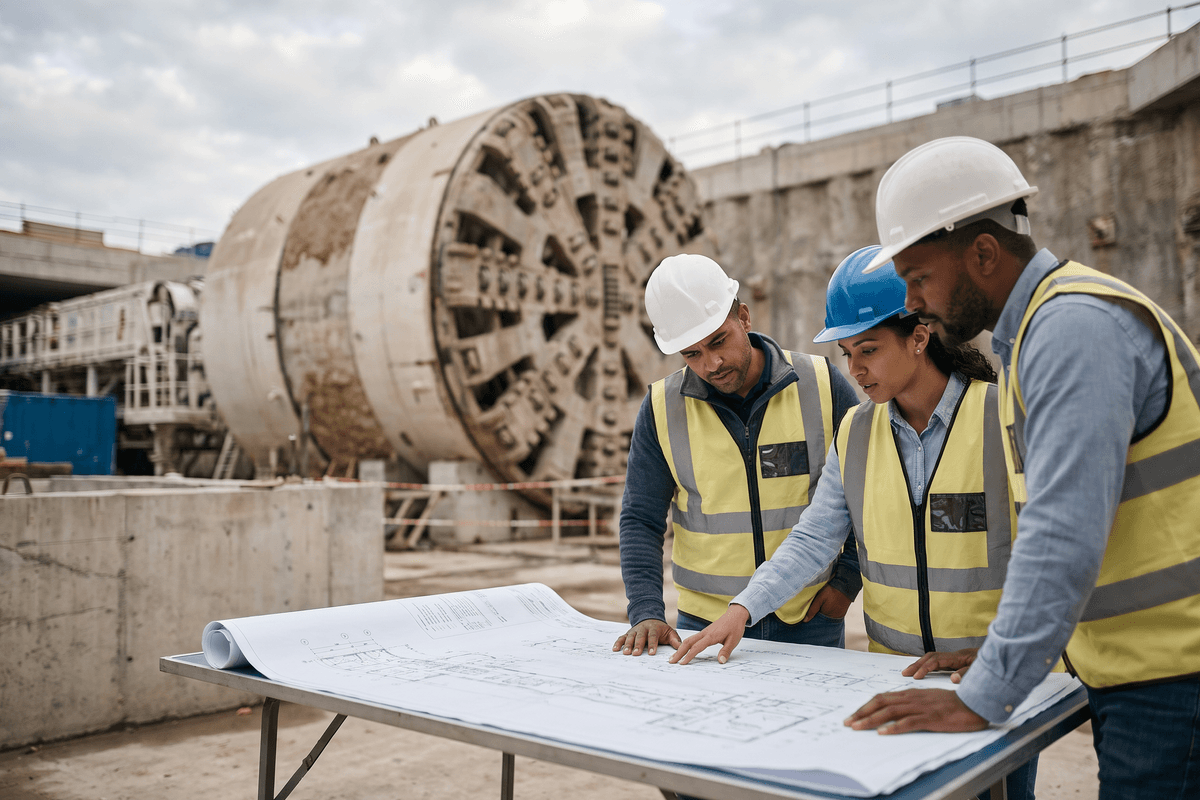



Deep beneath the basalt and clay of Auckland, a critical barrier has fallen. The removal of the final bulkhead on the Central Interceptor tunnel is more than just a dramatic photo opportunity; it is a watershed moment for New Zealand’s civil engineering sector. This breakthrough marks the transition of the country's largest wastewater infrastructure project from its primary excavation phase into the complex realities of connection, commissioning, and eventual operation.
For engineering professionals across Aotearoa, the Central Interceptor serves as a masterclass in risk allocation, geotechnical resilience, and long-term project endurance. But as we celebrate this subterranean victory, the broader industry is simultaneously grappling with a rapidly shifting landscape above ground. From the evolution of structural building materials to the looming financial cliff of the renewable energy transition, the parameters of how we design, fund, and build are changing.
The Central Interceptor: A Triumph of Subterranean Engineering
The removal of a final tunnel bulkhead is a delicate engineering operation. It represents the meeting point of immense hydrostatic pressures, precise spatial alignments, and the culmination of years of continuous Tunnel Boring Machine (TBM) operation. For the Central Interceptor—a 14.7-kilometre, 4.5-metre diameter pipeline designed to drastically reduce wastewater overflows into Auckland’s waterways—this milestone signals the beginning of the end of the heavy civil works.
The practical implications for the engineering teams involved now shift dramatically. The focus moves from geotechnical excavation to systems integration. Engineers must now manage the hydraulic testing, the installation of flow control structures, and the integration of the new tunnel with existing, aging legacy networks. It is a potent reminder that in modern infrastructure, the "breakthrough" is only the halfway point; the true test of engineering lies in operational commissioning.
"Mega-projects like the Central Interceptor redefine local capability. The intellectual property, project management frameworks, and technical skills developed in these trenches will seed the next generation of New Zealand's civil engineering leadership."
Celebrating the Human Element in Regional Delivery
While Auckland's mega-projects often dominate the headlines, the backbone of New Zealand's infrastructure resilience is distributed across the regions. The technical triumphs of our industry are intrinsically linked to the people executing them. This was recently highlighted as civil contractors gathered to celebrate the people and infrastructure shaping the Waikato.
The Waikato region has become a vital proving ground for transport logistics, regional water management, and heavy civil contracting. Acknowledging these regional teams underscores a vital truth for our sector: engineering is a deeply human endeavor. The retention of skilled project managers, site engineers, and heavy machinery operators is just as critical to our national infrastructure pipeline as the procurement of steel and concrete. As the Central Interceptor winds down its heavy civil phase over the coming years, absorbing and redeploying this highly skilled workforce into regional projects will be a strategic priority for national contractors.
Above Ground: The Shift to Engineered Building Systems
While civil engineers are mastering subterranean concrete, structural engineers are driving a revolution in the vertical built environment. The New Zealand construction industry is undergoing a systemic shift from traditional commodity timber to advanced engineered building systems.
For decades, standard stick-framing was the undisputed king of New Zealand residential and light commercial construction. Today, the demands for higher seismic resilience, tighter thermal envelopes, and reduced embodied carbon are pushing the industry toward Engineered Wood Products (EWPs) such as Cross-Laminated Timber (CLT), Laminated Veneer Lumber (LVL), and Glulam.
This transition fundamentally alters the structural engineering workflow:
- Design for Manufacture and Assembly (DfMA): Engineered systems require millimeter-perfect detailing during the design phase. The traditional approach of "sorting it out on site" is replaced by rigorous front-end digital modeling.
- Seismic Performance: Mass timber offers exceptional strength-to-weight ratios, allowing engineers to design highly resilient, flexible structures that perform predictably under seismic loading.
- Supply Chain Integration: Specifying engineered systems requires engineers to work much closer with manufacturers early in the procurement cycle, blurring the lines between structural design and industrial manufacturing.
The Looming Hurdle: Energy Transition and Affordability
We possess the technical capability to bore massive tunnels and construct innovative timber high-rises. Yet, the greatest challenge facing New Zealand's engineering sector over the next two decades is not purely technical; it is economic. As recent industry analysis highlights, the energy transition faces severe investment and affordability challenges.
To meet our net-zero targets and electrify the national fleet, New Zealand must build renewable generation and transmission infrastructure at a scale unseen since the Think Big era. However, the capital required is staggering, and the cost of capital has risen sharply. Engineers are caught in the middle of this "energy trilemma"—balancing sustainability, security of supply, and consumer affordability.
The Engineering Response to the Capital Crunch
When capital is constrained, engineering efficiency must increase. To navigate the affordability challenges of the energy transition, the sector must adapt its approach:
- Value Engineering Early: Moving away from gold-plated bespoke designs toward standardized, modular infrastructure that can be deployed rapidly across the grid.
- Asset Optimization: Using advanced telemetry, digital twins, and AI to squeeze more capacity out of existing transmission networks before committing to expensive physical upgrades.
- Regulatory Agility: Working closely with policymakers to ensure consenting processes for wind, solar, and geothermal projects do not add unnecessary millions to project balance sheets.
| Infrastructure Domain | Legacy Approach | Emerging Engineering Paradigm |
|---|---|---|
| Heavy Civil / Water | Reactive capacity upgrades, localized treatment. | Mega-scale network integration (e.g., Central Interceptor), extreme weather resilience. |
| Vertical Construction | Commodity timber, site-led problem solving. | Engineered wood products (CLT/LVL), DfMA, low embodied carbon. |
| Energy & Grid | Centralized generation, predictable baseload demand. | Distributed renewable integration, capital-constrained value engineering. |
Conclusion: Connecting the Dots
The removal of the final bulkhead on the Central Interceptor is a moment worthy of celebration. It is a physical manifestation of what New Zealand engineers can achieve when armed with bold vision, robust funding, and highly skilled regional workforces. Yet, as we look to the horizon, the nature of our challenges is shifting.
The future of New Zealand engineering will be defined by our ability to integrate new materials like engineered timber into our daily practice, while simultaneously solving the complex financial and technical equations of the renewable energy transition. The bulkheads of the future may not be made of concrete and earth, but of capital constraints and regulatory bottlenecks. It is up to the current generation of engineering professionals to break through them.