
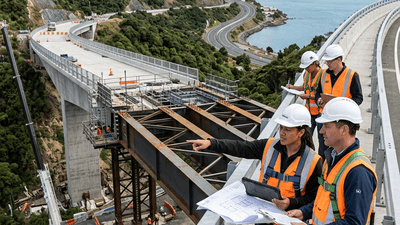



The days of the New Zealand engineer operating solely behind a drafting desk or a CAD screen are long gone. Today, the profession finds itself at the bleeding edge of the country's most pressing systemic challenges. From mitigating the fallout of extreme climate events to pioneering circular economies and safeguarding vulnerable supply chains, the modern engineer is a primary architect of national resilience. This evolution is not happening in a vacuum; it is being actively cultivated by industry leaders and philanthropic efforts focused on empowering the next generation.
A prime example of this capacity-building is the Engineering New Zealand Foundation. Over the past 12 months, the Foundation has reported continued, compounding progress in its mission to support the profession. Driven by robust industry support, the Foundation's outcomes reflect a broader truth: when we invest in the human capital of our engineering sector, we unlock solutions that ripple across every facet of New Zealand society.
Paving the Way: The Shift Toward Circular Materials
One of the most visible indicators of this expanded mandate is the shift toward sustainable, circular materials in civil infrastructure. A landmark example is unfolding in Glentunnel, where the Selwyn District Council has laid New Zealand's first full rubber road.
This trial involves testing three different rubberized asphalt surfaces, utilizing waste tyres that would otherwise occupy landfills. Beyond the obvious waste-reduction benefits, this approach targets a significant reduction in carbon emissions associated with traditional road construction.
Practical Implications for Civil Engineers
- Updated Specifications: Engineers must familiarise themselves with the performance metrics of rubberized bitumen, including its durability, skid resistance, and acoustic properties compared to conventional asphalt.
- Procurement Advocacy: Consulting engineers play a vital role in advising local councils on the long-term cost-benefit analysis of sustainable materials, helping to shift procurement models away from lowest-initial-cost to lowest-lifecycle-emissions.
- Supply Chain Integration: Scaling these solutions requires engineers to work closely with waste management sectors to ensure a consistent, high-quality supply of granulated rubber.
Systemic Resilience: Navigating Floods and Fuel Crises
While material innovation addresses our carbon footprint, adaptation to existing climate and geopolitical realities requires an equally urgent focus. Engineers are increasingly tasked with designing systems that can withstand severe shocks.
Redefining Flood Risk and Insurability
Climate change is already delivering larger and more frequent extreme weather events across Aotearoa. Consequently, the conversation around mitigating flood risk and navigating insurance has undergone a seismic shift. Insurers are rapidly adjusting their risk profiles, moving away from blanket coverage to highly localized, risk-adjusted premiums—or in some cases, withdrawing coverage entirely.
"If a piece of infrastructure or a commercial development cannot be insured, it cannot be financed. Engineers are no longer just designing to meet the Building Code; they are designing to meet the strict thresholds of global reinsurers."
For structural and civil engineers, this means adopting a "beyond-code" mentality. Site selection, elevated floor levels, permeable surfaces, and robust stormwater attenuation systems are no longer optional value-adds; they are prerequisites for financial viability.
The Vulnerability of Liquid Fuels
Resilience is not limited to water; it extends to energy. Engineering consultant Nathan Surendran recently highlighted the critical situation of New Zealand's fuel reserves. As an island nation heavily reliant on imported liquid fuels, our supply chains are acutely vulnerable to geopolitical disruptions and logistical bottlenecks.
Surendran's analysis underscores the need for immediate emergency planning. For engineering professionals, this highlights a critical design parameter: energy autonomy. Whether designing hospital backup systems, agricultural processing plants, or municipal water treatment facilities, engineers must factor in the potential for prolonged liquid fuel shortages. This necessitates a faster transition to decentralized renewable energy grids, battery storage, and electrified transport logistics.
Optimising the Primary Sector: Food Production and Waste
New Zealand's economic backbone remains its primary sector, but agriculture is facing dual pressures: the need to increase yields to feed a growing global population and the imperative to drastically reduce environmental impact. Engineers are the linchpins in the quest for producing food and reducing waste.
Process, mechanical, and agricultural engineers are driving innovations in precision agriculture, automated harvesting, and advanced refrigeration logistics. By optimizing thermodynamic processes in dairy plants or designing smarter irrigation systems that respond to real-time soil moisture data, engineers are directly reducing both water usage and biological waste.
The Bottom Line: Engineering as an Economic Driver
While the societal and environmental impacts of engineering are profound, the commercial value of the profession remains its most persuasive metric for clients. A recent report from ACE New Zealand, highlighted by FIDIC, quantifies the real and lasting value that engineering consultancy firms bring to construction and infrastructure projects.
The data is compelling: engineering consultancies save clients nearly $2 billion annually through optimized design, risk mitigation, and lifecycle planning. This front-loaded value proves that investing in robust engineering early in a project's lifecycle is not a cost center, but a critical cost-saving mechanism.
The Shifting Engineering Paradigm
| Domain | Traditional Focus | Emerging Resilience Focus |
|---|---|---|
| Materials & Transport | Load capacity, initial capital expenditure | Circular economy (e.g., rubber roads), embodied carbon |
| Civil & Structural | Building Code compliance, life safety | Asset insurability, extreme weather adaptation |
| Energy & Systems | Efficiency under normal operating conditions | Supply chain autonomy, liquid fuel independence |
| Agriculture | Maximum yield and throughput | Precision resource management, zero-waste processing |
Conclusion: Designing Tomorrow, Today
The past 12 months have clearly demonstrated that New Zealand relies on its engineers for much more than technical drawings. Whether it is the Engineering New Zealand Foundation fostering the next generation of diverse talent, civil engineers trialling recycled tyres on our rural roads, or systems engineers fortifying our energy and food networks, the profession is expanding its boundaries.
As we look to the future, the challenge for New Zealand engineering professionals is to fully embrace this multifaceted role. By continuing to leverage industry data, advocate for sustainable procurement, and design for systemic resilience, engineers will not only save their clients billions but will fundamentally safeguard the future of Aotearoa.