
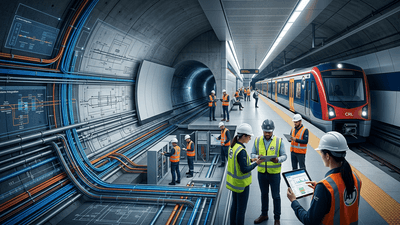



Auckland’s City Rail Link (CRL) represents a watershed moment in New Zealand’s civil engineering history. For years, the industry has watched tunnel boring machine Dame Whina Cooper carve through the city's subterranean basalt, marvelling at the complex geotechnical and structural feats achieved beneath a bustling CBD. Yet, as the project inches toward its highly anticipated launch, a sobering reality is emerging: the physical infrastructure may be ready, but the operational system is facing constraints.
According to recent reports from 1News, public transport advocates are warning that passengers on Auckland's Western train line may actually face fewer rush hour trains when the CRL opens than were previously trialled. For engineering professionals—particularly those in systems integration, transport planning, and infrastructure delivery—this news highlights a critical industry friction point: the vast delta between a mega-project's designed capacity and its day-one operational reality.
The Systems Engineering Bottleneck
To the public, a rail network is a simple equation: tracks plus trains equals transport. But for systems engineers, a modern metropolitan rail network is a highly complex, interdependent web of civil structures, traction power, advanced signalling, rolling stock availability, and crew rostering. When any one of these subsystems faces a bottleneck, the entire network's capacity is throttled.
The CRL was fundamentally designed to double the capacity of Auckland's rail network by turning the downtown Britomart station from a dead-end terminus into a two-way through-station. The physical tunnels and stations are engineered to handle up to 54 trains an hour at peak times. However, achieving that throughput requires more than just clear tracks.
Signalling and Headways
One of the primary engineering challenges in maximizing the CRL's capacity is the integration of the European Train Control System (ETCS). While ETCS Level 2 allows for moving block signalling—enabling trains to run safely at closer headways—the transition from legacy systems and the rigorous safety validation required for a subterranean network dictate a conservative approach to day-one operations.
"A transport network is only as strong as its most constrained subsystem. You can bore a tunnel capable of handling a train every two minutes, but if your signalling integration requires a three-minute headway for safety validation, your operational capacity is instantly reduced by a third."
Rolling Stock and Power Constraints
The revelation that the Western Line may experience reduced peak services points directly to resource allocation challenges. A through-routed network requires a larger fleet of Electric Multiple Units (EMUs) to maintain high-frequency services across all lines simultaneously. If procurement timelines for new rolling stock do not perfectly align with the completion of civil works, network planners are forced to spread a limited fleet over an expanded operational footprint.
Furthermore, traction power upgrades across the wider Auckland network must be fully commissioned to support the increased electrical load of running more trains simultaneously. If substations outside the immediate CRL footprint are not fully upgraded, power draw limitations will artificially cap the number of trains that can operate during peak hours.
| Metric | Designed Capacity (Ultimate) | Anticipated Day-One Reality | Primary Engineering Constraint |
|---|---|---|---|
| Peak Throughput | Up to 54 trains per hour | Significantly constrained, reallocated across lines | Rolling stock availability & crew training |
| Britomart Function | Two-way through station | Two-way through station | None (Civil engineering objective met) |
| Signalling Headways | Optimized moving block (ETCS L2) | Conservative fixed/buffered blocks | System integration testing & safety validation |
| Western Line Peak | High-frequency turn-up-and-go | Potentially fewer trains than prior trials | Fleet allocation & network-wide balancing |
The Western Line Integration Challenge
The specific impact on the Western Line is a classic study in network integration. Prior to the CRL, the Western Line operated with specific operational patterns dictated by the Britomart bottleneck. With the CRL opening, the network topology changes from a radial system to a continuous loop (or through-routed) system.
While this is highly efficient in the long term, it means that a delay or capacity constraint on the Southern or Eastern lines now ripples directly into the Western line. Network planners often have to implement conservative timetables during the initial months of a topological shift to ensure reliability, sacrificing peak frequency for predictability. For engineers involved in timetable modelling and operations research, this is a known phase of "burn-in" for new infrastructure.
Lessons for New Zealand's Future Mega-Projects
As New Zealand continues to plan future mega-projects—such as additional Waitematā Harbour crossings or mass rapid transit in Wellington and Christchurch—the CRL's operational teething issues provide invaluable lessons for the engineering sector:
- Holistic Procurement is Non-Negotiable: Civil infrastructure contracts must be inextricably linked to the procurement of rolling stock and operational systems. A tunnel without enough trains is a stranded asset.
- System Integration Takes Time: The physical completion of a project is merely the beginning of the systems integration phase. Project timelines must explicitly account for months of "ghost running" and safety validation.
- Managing Public Expectations: Engineers and project leaders must communicate the difference between "Day One" capacity and "Ultimate" capacity. Infrastructure matures over time as operational confidence grows.
- Network-Wide Upgrades: A multi-billion-dollar central asset will expose the weaknesses of legacy infrastructure on the network's periphery. Upgrades to traction power, level crossings, and stabling yards must be funded concurrently.
Looking Ahead: The Phased Reality of Infrastructure
The news that the City Rail Link may open with a whimper rather than a roar regarding peak train frequencies is undoubtedly frustrating for commuters. However, for engineering professionals, it is a reminder of the realities of deploying complex, integrated systems in a live urban environment.
The civil engineering achievement of the CRL remains monumental. The foundations for a world-class transit system have been laid. The focus must now shift to the operational engineers, systems integrators, and transport planners who will spend the next several years optimizing the network, procuring the necessary fleet, and slowly turning the dial up to reach the infrastructure's true designed capacity. In modern infrastructure, opening day is not the finish line—it is simply the end of the beginning.