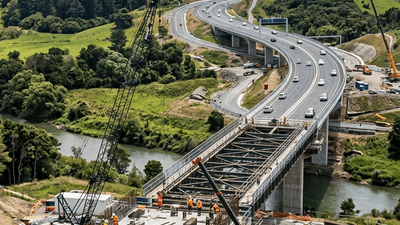
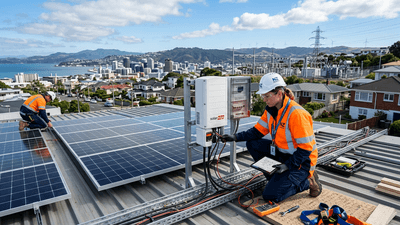
In an era where hyper-specialisation is often heralded as the ultimate career path, New Zealand’s engineering sector continues to prove the immense value of cross-sector agility. From the depths of our marine environments to the rugged peaks of the Southern Alps, and straight up into regional airspace, Kiwi engineers are demonstrating an uncanny ability to transfer skills across seemingly disparate domains. Recent developments across defence technology, aerospace, civil infrastructure, and seismic resilience highlight a unifying theme: the most groundbreaking solutions often emerge when we apply the expertise of one industry to the challenges of another.
Key Takeaway: The future of New Zealand engineering is increasingly collaborative and ...
For New Zealand’s engineering sector, 2026 is rapidly becoming the year of regulatory whiplash. On one front, the profession is bracing for sweeping operational changes as the Government pushes forward with the Building Amendment Bill. On the other, engineers are grappling with the reality of a newly passed Health and Safety legislation that industry advocates say has ...
For decades, New Zealand’s engineering and construction sectors have wrestled with a frustrating dual paradox: an infrastructure pipeline plagued by political whiplash, and a liability framework that routinely penalises the most responsible parties. When projects failed, the 'last man standing'—often the consulting engineer or the local council—was left holding the financial ...
Walk into any major engineering consultancy in Auckland, Wellington, or Christchurch, and you will inevitably hear the same operational lament: "We simply cannot find enough people." Yet, look at the graduation stages of our leading universities, and you are presented with a seemingly contradictory picture. According to a recent report by Engineering New Zealand , ...
For decades, New Zealand’s infrastructure pipeline has resembled a pendulum, swinging violently with every three-year election cycle. For engineering consultancies and contractors, this boom-bust rhythm has made long-term workforce planning, capital investment, and procurement optimization an exercise in educated guessing. But a historic shift is underway, one that promises ...
For decades, the engineering profession in Aotearoa New Zealand has wrestled with a pervasive, if somewhat unfair, public branding problem. The traditional stereotype paints the engineer as a brilliant but strictly analytical background figure—someone who crunches the numbers, signs off on the structural integrity, and quietly recedes into the shadows of a project. However, ...
New Zealand’s breathtaking topography comes with a steep price. Geologically young, tectonically active, and frequently battered by intense Pacific weather systems, our landscape is inherently restless. For generations, civil and geotechnical engineers have battled the realities of slope instability. However, as climate change loads the dice for extreme rainfall ...
For New Zealand's engineering sector, a government budget is rarely just a fiscal document; it is a blueprint for the next decade of operational reality. With the unveiling of Budget 2026 , the industry has been handed a clear, highly capitalized mandate: a $7 billion capital infrastructure investment earmarked for hospitals, schools, roads, and rail. But while the ...
Engineering in Aotearoa is a discipline increasingly defined by its extremes. On one end of the spectrum, we are pushing the boundaries of material science and sustainable design to deliver world-class infrastructure. On the other, the stark reality of professional liability serves as a sobering reminder that our margins for error are razor-thin. For New Zealand's engineering ...
New Zealand is racing toward a decentralized, renewable energy future, but there is a familiar, frustrating speed bump on the roof: compliance. For years, the push to blanket our residential and commercial rooftops in photovoltaic (PV) panels has run headfirst into a web of structural assessments, electrical inspections, and localized network approvals. Now, the regulatory ...
When we discuss the future of New Zealand engineering, the conversation naturally gravitates toward sweeping infrastructure mega-projects, systemic grid overhauls, or the latest developments in seismic resilience. Yet, any seasoned engineer knows that the true battle for operational efficiency is won or lost in the details. It is fought in the plant rooms, on the machine shop ...
For decades, structural engineers in New Zealand have designed buildings to withstand the violent shaking of earthquakes by focusing on peak ground acceleration, spectral acceleration, and the duration of the seismic event. We have largely modeled the end of an earthquake as a tapering off—a gradual decay of seismic energy as the fault rupture slows. But what happens if the ...
The Sweet Taste of Systems Engineering
On a sweltering New Zealand summer afternoon, a scoop of ice cream feels less like a marvel of industrial engineering and more like a simple fact of life. Yet, beneath the smooth texture and sweet flavor lies a complex, century-old story of thermodynamic mastery, mechanical ingenuity, and supply chain logistics. The journey of ...